Top Website Conversion Audit Services for Small Businesses
Discover the top website conversion audit services for small businesses in 2026, pricing, speed, and best fits from $0 tools to $5K+ agencies. Explore.
TL;DR
The median website converts at just 2.35%, while top performers hit 11.45%. A conversion audit finds what’s broken. For small businesses, the best options range from free AI-powered audits (Conversion Score, Microsoft Clarity) to budget behavioral tools (Lucky Orange at $9/month) to premium agency engagements ($5,000+). This guide compares 9 services across price, speed, and small-business fit so you can pick the right one for your budget.
Why Small Businesses Need a Conversion Audit Right Now
The gap between average and excellent conversion rates is staggering. Research shows the median site converts at 2.35%, but the top 10% of websites reach 11.45%, converting at nearly five times the rate of the average. For a small business with 100,000 monthly visitors and a $100 average order value, moving from a 2% to a 4% conversion rate means an extra $200,000 in monthly revenue. The fastest path to revenue growth isn’t always more traffic. It’s fixing what you already have.
Yet most small businesses don’t know where to start. They suspect their site underperforms but lack the in-house expertise to diagnose why. That’s exactly what conversion rate optimization audits are designed to solve.
Mobile experience is often the biggest culprit. Mobile converts at just 1.82% versus desktop’s 3.14%, a 42% gap that signals broken mobile UX on most small business sites. And blind redesigns fail 73% of the time, compared with a 27% success rate for data-driven optimizations. An audit gives you the data.
This guide covers the top website conversion audit services for small businesses, spanning AI audit tools, behavioral analytics platforms, freelance auditors, and full-service agencies. Every option includes real pricing, because that’s the information most comparison pages hide.
Run a free website conversion audit
How We Evaluated These Services
Every service was assessed on five criteria specific to small business needs:
- Pricing transparency. Actual dollar amounts, not “contact us” pages.
- Speed to insights. Days or weeks matter when you’re running lean.
- SMB-friendliness. Does the tool or service assume enterprise budgets and traffic volumes?
- Real user reviews. Verified sentiment from G2, Capterra, Clutch, and practitioner communities.
- Honest tradeoffs. What it doesn’t do well, not just feature lists.
The services fall into three categories: AI audit tools (instant diagnostics), behavioral analytics (DIY data collection), and human-led services (freelancers and agencies).
At-a-Glance Comparison Table
| Service | Starting Price | Speed | Best For | DIY vs. Done-For-You | Free Option |
|---|---|---|---|---|---|
| Conversion Score | $0 / $99/mo Pro | ~90 seconds | Quick AI diagnostics, agencies | Guided DIY (AI) | Yes |
| SiteTuners | $5,000+ per audit | 4–6 weeks | Established SMBs, e-commerce | Done-for-you | No |
| Hotjar / Contentsquare | $0 / $49/mo Growth | Needs traffic data | DIY behavior research | DIY | Yes (limited) |
| Microsoft Clarity | $0 (always free) | Needs traffic data | Zero-budget starting point | DIY | Yes, unlimited |
| Crazy Egg | $29/mo (annual only) | Needs traffic data | Heatmaps + simple A/B tests | DIY | No (trial only) |
| Lucky Orange | $9/mo | Needs traffic data | Budget Shopify stores | DIY | No |
| VWO | ~$314/mo | Needs traffic data | Mid-market testing programs | DIY + managed | Being discontinued |
| Freelance Auditors | $75–$2,900 | 2 days–4 weeks | One-time human-led review | Done-for-you | No |
| Invesp | $7,000+/mo | Ongoing | Enterprise / funded startups | Done-for-you | No |
The 9 Best Website Conversion Audit Services for Small Businesses
1. Conversion Score
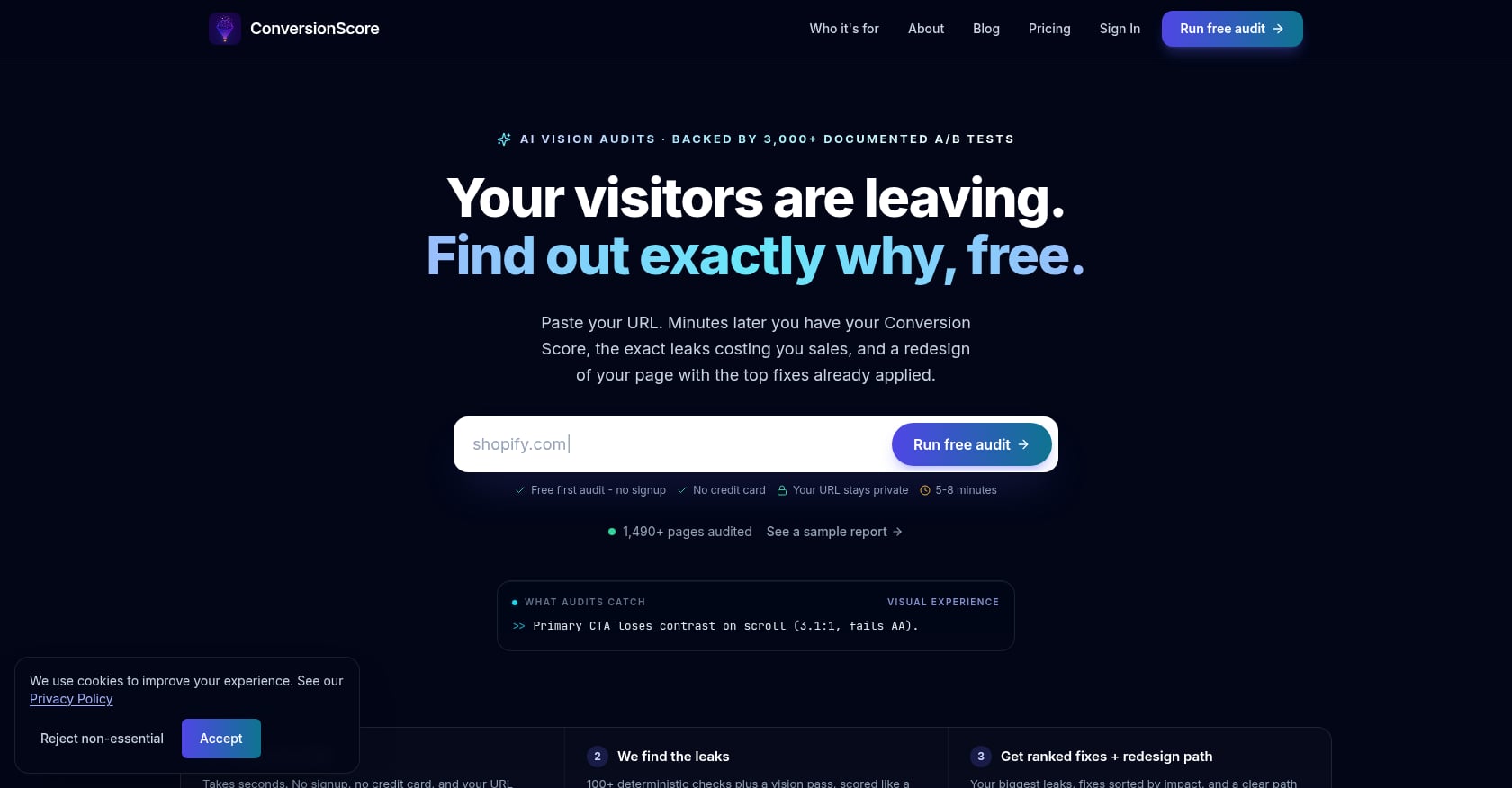
Best for: Small businesses and agencies that want instant, structured conversion diagnostics without installing scripts or waiting for data.
Conversion Score is an AI-powered conversion analysis platform that uses GPT-5 Vision and DOM analysis to audit any web page across six weighted pillars: Clarity & Value, Offer Strength, Trust & Credibility, Friction & Usability, Urgency & Motivation, and Visual Experience. You paste a URL, and the platform returns a weighted ConversionScore with prioritized recommendations in roughly 90 seconds.
Pricing:
- Free plan: One analysis with top 2 insights, no credit card required
- Pro Monthly: $99/month
- Pro Annual: $948/year (saves two months)
- Pro includes unlimited audits, full 6-pillar reports, competitor analysis, SWOT insights, AI expert chat, and PDF downloads
Key features:
- No script installation needed, just paste a URL
- Weighted scoring system with step-by-step action items
- Competitor side-by-side analysis and SWOT insights
- AI expert chat for clarifying findings and drafting copy alternatives
- One-click PDF exports for client or stakeholder delivery
- Free CRO tools suite including calculators, A/B planner, and UX audit
Why it ranks first for small businesses: At $99/month for unlimited audits versus $5,000 to $15,000 for a single agency audit, the cost structure is fundamentally different. More importantly, it doesn’t require traffic to generate insights. This matters because small business CRO is constrained by traffic volume. If your site gets fewer than 10,000 monthly sessions, behavioral tools like heatmaps need weeks to collect meaningful data. AI heuristic analysis works on the page itself, right now.
Tradeoffs:
- Not a session-replay or analytics platform. No click maps or behavioral recordings. Best used alongside tools like Clarity or Hotjar for qualitative playback.
- Not a testing platform. You still need VWO or Optimizely to validate changes through A/B testing.
- AI heuristic audits can produce false positives if a page’s strategy (like intentionally long-form content) conflicts with standard heuristics. Human judgment still matters.
- No public integrations or analytics connectors. Improvement tracking relies on re-auditing or separate analytics.
- The product is relatively new (launched mid-2025), and there are no G2 or Capterra listings as of early 2026.
Real user perspective: Practitioners on Reddit (r/SaaS, r/indiehackers) discussed the product’s features during its August-September 2025 launch, noting the ConversionScore framework, AI chat, and SWOT analysis. One user did report a “Report not found” error, suggesting the platform is still maturing.
The editorial case for leading with Conversion Score is straightforward: among top website conversion audit services for small businesses, nothing else combines this speed, this price point, and this level of structured output. It’s the right first step before investing in behavioral tools or agency work.
2. SiteTuners
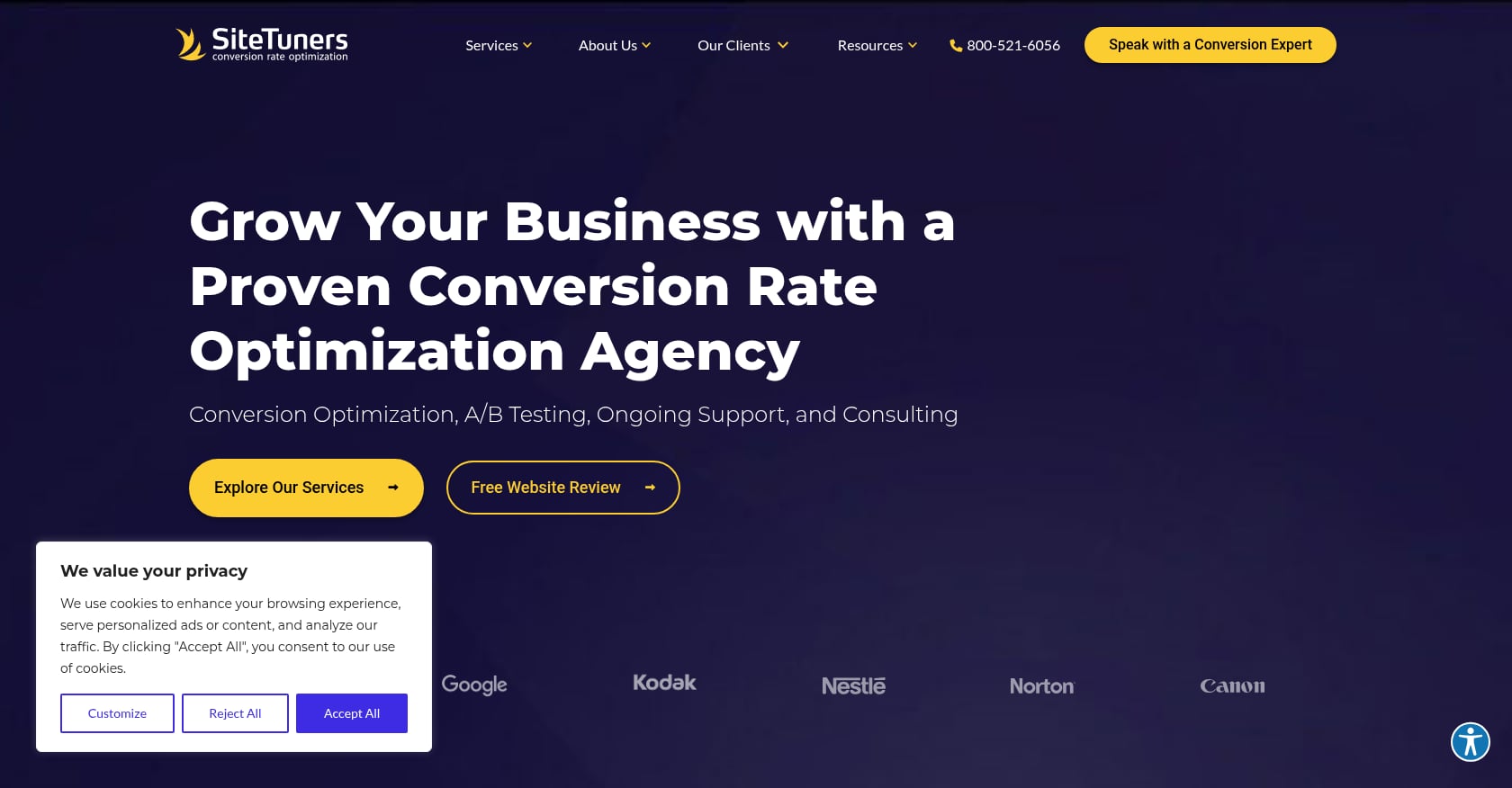
Best for: Established small businesses with real budgets ($5K+) that want human-led, neuromarketing-grounded analysis.
SiteTuners is a conversion rate optimization agency founded in 2002. They’ve worked with over 2,100 businesses and claim more than $1 billion in additional revenue generated for clients. Their approach blends behavioral psychology with systematic page-level auditing.
Pricing:
- One-time audits: $5,000 to $25,000
- Ongoing programs: $5,000 to $20,000/month
- Also offers a 90-minute CRO Expert Review for businesses that want targeted advice without a full engagement
- Timeline: 4 to 6 weeks for a complete audit
Key features:
- Human expert analysis grounded in neuromarketing and behavioral science
- 20+ years of CRO experience with documented case studies
- Full-service: audit through implementation recommendations
- Applicable across e-commerce, SaaS, and lead generation
Tradeoffs:
- Premium pricing puts it beyond reach for most micro and early-stage small businesses
- 4 to 6 week delivery is slow for fast-moving teams
- Some Clutch reviewers suggest the agency should introduce more cost-effective options for smaller budgets
Real user perspective: On Clutch (45 reviews), multiple clients report substantial conversion rate increases, with some businesses citing revenue growth of up to 45% year-over-year. The quality of human analysis is consistently praised, though budget-constrained reviewers wish for lighter-weight engagement options.
3. Hotjar / Contentsquare
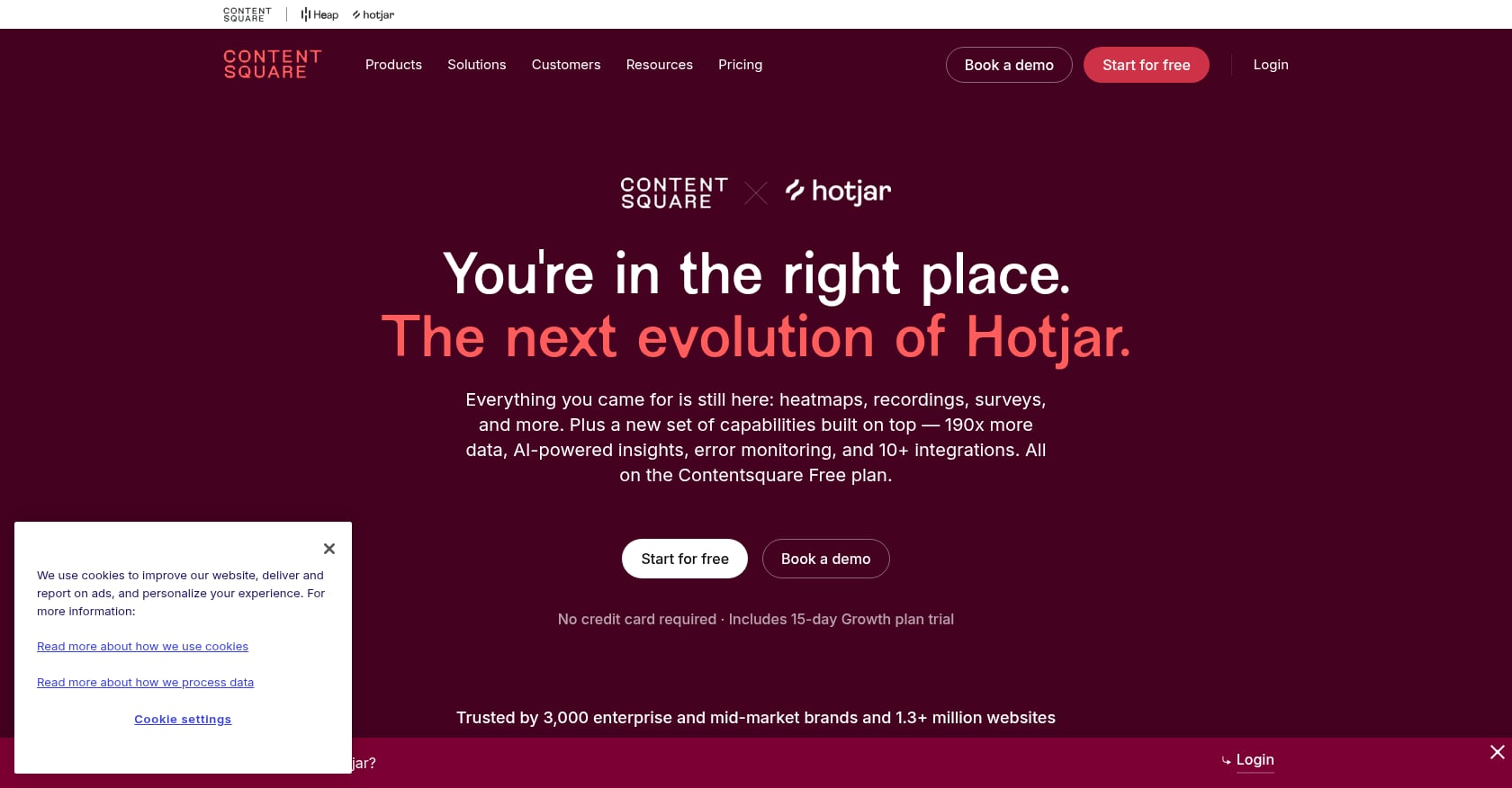
Best for: Small businesses that want to run their own behavioral research and have the time to interpret heatmaps and recordings.
Hotjar is the well-known session recording and heatmap tool that helps teams understand user behavior visually. In 2023, Contentsquare acquired Hotjar, and by 2026 the merger has fundamentally changed the pricing model.
Pricing:
- Free tier available (limited sessions)
- Experience Analytics (heatmaps/recordings): from $49/month
- Voice of Customer (surveys): from $99/month
- Product Analytics: custom pricing
- The Growth plan’s $49/month starting price scales steeply with session volume, reaching up to $739/month at 200K sessions
Key features:
- Session recordings and heatmaps for visual behavior analysis
- Surveys and feedback widgets (separate product tier)
- Funnels and form analysis for identifying drop-off points
- Integrations with most major platforms
Tradeoffs:
- Requires script installation and actual traffic to generate data. Low-traffic sites need weeks to collect useful recordings.
- The tool shows you what happened but doesn’t tell you what to fix. Interpretation is on you.
- The Contentsquare transition has created real pricing confusion. What used to be one product with one bill is now three separately priced product lines. Practitioners on forums describe needing a spreadsheet to calculate their total cost.
Real user perspective: Users across review platforms recognize Hotjar’s value for UX research, but the post-merger pricing changes have pushed some to reconsider. The old Hotjar pricing was simple: one plan, one price. The current structure requires navigating multiple product tiers with separate billing. For a deeper comparison of quick audit approaches, it’s worth understanding where each tool fits.
4. Microsoft Clarity
Best for: Any small business at zero budget that wants real behavioral data without paying a cent.
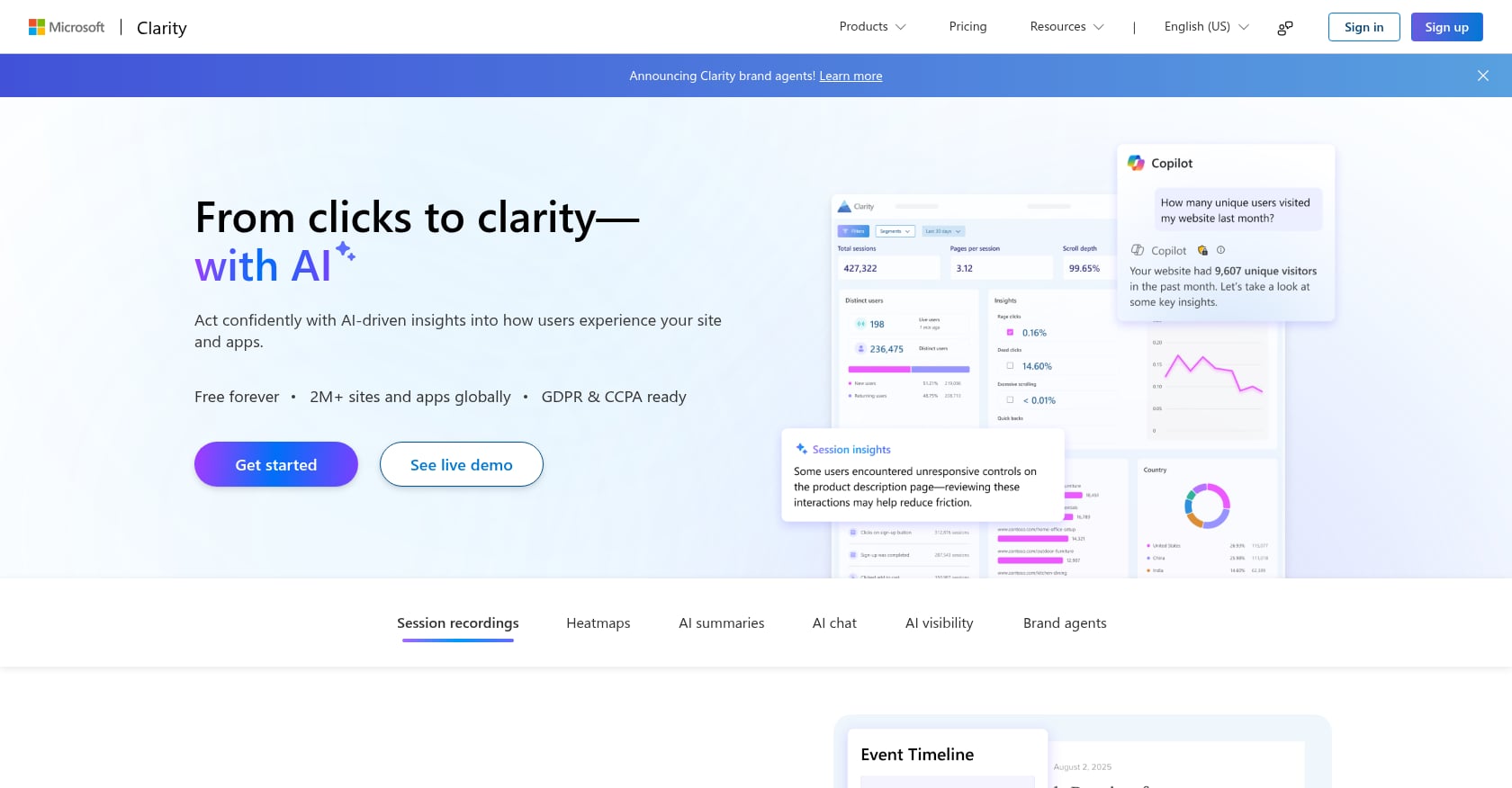
Microsoft Clarity records every session on your website, builds heatmaps, and flags user frustration signals like rage clicks and dead clicks. The price is zero, forever. There are no hidden traffic limits or forced upgrades.
Pricing:
- Free. Completely. No caps on recordings, no paid tiers.
Key features:
- Unlimited session recordings and heatmaps
- Frustration detection (rage clicks, excessive scrolling, dead clicks)
- Google Analytics integration
- GDPR-compliant with IP masking options
Tradeoffs:
- Zero survey or user feedback capabilities
- No funnel analysis or form analytics, both of which are critical for specific CRO use cases
- 30-day data retention limits historical analysis
- Some privacy-conscious businesses may hesitate at sending all session data to Microsoft
Real user perspective: One Capterra reviewer noted: “We use Clarity on our own, plus every client website we work with. Being able to view each website’s heat mapping to help from a CRO perspective has brought a ton of new insight.” The general consensus among practitioners is that Microsoft Clarity gives you roughly 80% of what paid alternatives offer at 0% of the cost. For small businesses just starting with conversion analysis, pairing Clarity’s behavioral data with an AI audit tool creates a solid foundation without spending anything.
5. Crazy Egg
Best for: Small businesses that want heatmaps and simple A/B testing in a single tool.
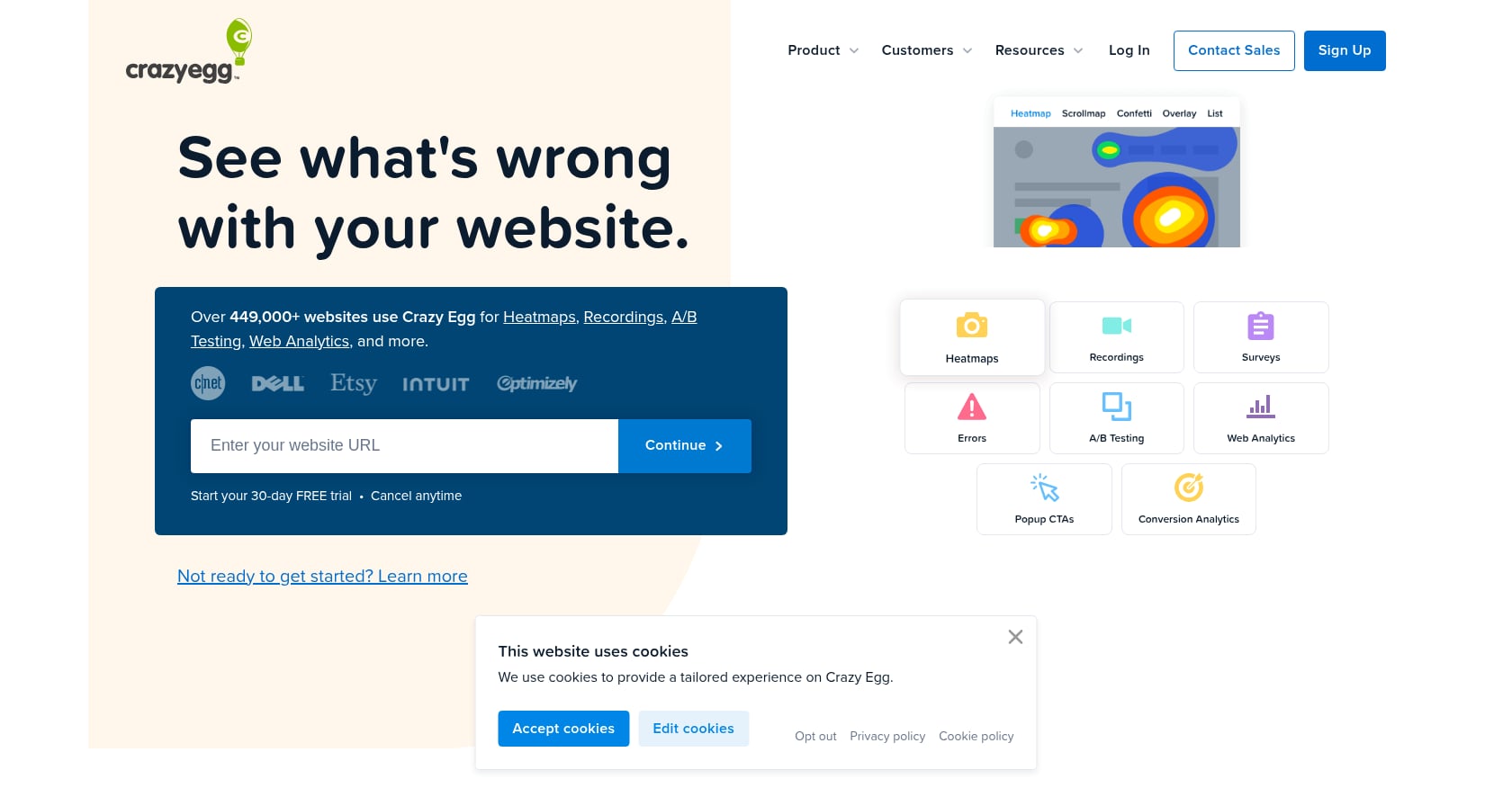
Crazy Egg has been in the heatmap space for years, offering scroll maps, confetti reports, session recordings, and (importantly) built-in A/B testing starting at the $99/month tier.
Pricing:
- Four tiers: $29, $99, $249, and $599 per month
- All plans require annual billing. There is no month-to-month option.
- No permanently free plan, only a trial
Key features:
- Heatmaps, scroll maps, and confetti reports
- Session recordings
- Built-in A/B testing (from $99/mo tier)
- Snapshots for tracking changes over time
Tradeoffs:
- Annual-only billing is a meaningful commitment, especially for budget-sensitive small businesses evaluating conversion audit services
- The $29/month Starter plan includes just 5,000 tracked pageviews. That sounds generous until you realize a visitor who hits your homepage, clicks to a service page, and then visits your contact form has consumed three of them.
- Pricier than competing tools for comparable functionality
Real user perspective: Capterra reviewers praise Crazy Egg’s ease of use, noting it requires no coding skills to set up. Data visualization is consistently cited as a strength. However, multiple reviewers flag that it’s more expensive than competitors like Hotjar or Lucky Orange for similar features.
6. Lucky Orange
Best for: Budget-conscious Shopify stores and small e-commerce businesses that want behavior analytics at the lowest entry price.
Lucky Orange combines heatmaps, session recordings, conversion funnels, and built-in polls in a single platform. It’s particularly popular with Shopify merchants due to its native integration.
Pricing:
- Starter: $9/month
- Small Business: $18/month
- Medium: $45/month
- Large: $90/month
Key features:
- Heatmaps and session recordings
- Conversion funnels showing step-by-step drop-off
- Live chat widget included
- Built-in polls for quick visitor feedback
- Shopify app store integration
Tradeoffs:
- Session limits scale with plan tier, and some users report that caps feel restrictive as traffic grows
- Less sophisticated analysis than enterprise tools
- Limited A/B testing capabilities compared to Crazy Egg or VWO
Real user perspective: On G2 (4.6 stars, 345 reviews), users describe Lucky Orange as “incredibly useful for understanding how customers actually interact with your website.” Heatmaps and session recordings are praised for detecting small UX issues that analytics dashboards miss. The main criticism centers on session limits, with users noting that costs can climb as their site grows.
7. VWO
Best for: Small-to-mid-market businesses with 50K+ monthly visitors and the budget to run a proper testing program.
VWO is a comprehensive CRO platform that bundles A/B testing, multivariate testing, and split testing with heatmaps, session recordings, form analytics, surveys, and personalization. It’s a serious platform for teams ready to move beyond auditing into systematic experimentation.
Pricing:
- Starting price: approximately $314/month (billed annually) for up to 10,000 monthly tracked users
- According to Vendr, VWO costs a median of $18,086 per year, with prices ranging between $7,200 and $41,712
- The free Starter plan is being discontinued. Existing free users have been notified, and new sign-ups only receive a 30-day trial.
Key features:
- Full A/B, multivariate, and split URL testing
- Heatmaps, session recordings, and form analytics
- On-page surveys
- Personalization engine
- Statistical rigor built into the testing framework
Tradeoffs:
- Pricing is optimized for high-volume testing, which makes it overkill for most small businesses
- The minimum $314/month investment (annual commitment) is steep before you’ve even identified what to test
- Requires enough traffic for tests to reach statistical significance. If your site gets fewer than 50K sessions a month, tests drag on for weeks without conclusive results.
- Free tier disappearing makes the barrier to entry even higher
Real user perspective: G2 reviewers from small businesses frequently flag pricing as a barrier, noting that VWO’s structure is built for teams with sustained, high-volume testing needs. For a more detailed comparison of pre-test diagnostics approaches, consider whether your traffic volume justifies this investment.
8. Freelance CRO Auditors
Best for: Businesses that want a human perspective on their site but can’t afford a full agency engagement.
Freelance CRO specialists on platforms like Fiverr, Upwork, and Dribbble offer one-off manual audits at a fraction of agency pricing. Quality ranges enormously.
Pricing:
- Fiverr: $75 to $175 for basic audits
- Dribbble: approximately $2,900 for a comprehensive 15-day UX/CRO audit
- Upwork: rates vary from $200 to $20,000 depending on auditor experience and scope
- Timeline: 2 days to 4 weeks depending on depth
Key features:
- Human judgment and pattern recognition
- Customized to your specific business context
- Can include competitive analysis, user flow review, and copy recommendations
- Often includes a written report or video walkthrough
Tradeoffs:
- Quality is wildly inconsistent. There’s no standardized output.
- No guarantee of follow-through or implementation support
- Zero scalability, you pay per audit, every time
- Vetting freelancers takes time and carries risk, especially at the lower price points
- A manual CRO audit done by a human takes at least 2 weeks to a month to complete
Real user perspective: On G2, users of Shopify-focused CRO auditors praised fast turnaround, with one noting: “Just submitted the website URL, they sent the full report after 2 days.” The best freelancers deliver genuine insight. The challenge is finding them. Practitioners on forums observe that automated tools handle basic audits in minutes, but manual practitioners consider them less thorough. The counter-argument: at $5K+ for a manual audit, most small businesses are priced out entirely. For a direct cost comparison, see this breakdown of agency audit costs vs. AI audits.
9. Invesp
Best for: Funded startups and established brands with significant traffic that want a research-heavy, long-term CRO partner.
Invesp is one of the oldest dedicated CRO agencies in the market, founded in 2006. They operate with a proprietary conversion framework and focus on e-commerce, SaaS, and lead generation businesses.
Pricing:
- Starting at $7,000 per month
- Full engagement pricing ranges from $7,500 to $300,000 depending on scope and client size
Key features:
- Proprietary conversion optimization framework
- Deep research methodology combining qualitative and quantitative data
- Full-funnel optimization: landing pages, checkout, messaging, CTAs
- Long track record with documented case studies
Tradeoffs:
- At $7K+ per month, this is enterprise pricing. Most true small businesses are priced out.
- Not the right fit for early-stage businesses or those with limited traffic
- Long-term engagement model, not suited for quick one-off audits
Real user perspective: One G2 reviewer shared: “Invesp helped us audit our marketing messaging, and we immediately saw a lift in conversions on paid ads. They also weighed in on landing page design, the checkout funnel, CTA placement across our site.” The quality of work is rarely questioned. The question is whether the investment makes sense at your scale.
When to Use Which: A Decision Framework by Budget
Choosing among these top website conversion audit services for small businesses comes down to budget, traffic volume, and internal capability. Here’s a practical framework:
Budget under $100/month: Start with Conversion Score’s free tier for instant page diagnostics and Microsoft Clarity for ongoing behavioral data. This combination costs nothing and gives you both AI-powered recommendations and real user session data.
Budget $100 to $500/month: Upgrade to Conversion Score Pro ($99/month) for unlimited audits and competitor analysis, then pair it with Lucky Orange ($9–$18/month) or Hotjar’s free tier for behavioral validation. This stack covers diagnostics and data collection for under $120/month.
Budget $1,000 to $5,000 (one-time): Commission a freelance CRO audit ($500–$2,900) for human-led analysis, then use Clarity for ongoing monitoring and Conversion Score for periodic check-ins. This approach gets you expert eyes without ongoing agency fees.
Budget $5,000+ per month: Engage a dedicated agency like SiteTuners or Invesp for full-service optimization. At this tier, you’re buying implementation support and testing programs, not just diagnostics.
The critical insight most comparison articles miss: small business CRO is fundamentally constrained by traffic volume. Don’t A/B test a store with 1,000 sessions per month, because you’ll never hit statistical significance. For low-traffic sites, AI heuristic audits and qualitative tools (session recordings, user polls) are more valuable than testing platforms.
What a Good Conversion Audit Should Cover
Regardless of which service you choose, a thorough conversion audit should examine your site across multiple dimensions, not just “move the button” surface-level advice.
A strong framework evaluates six pillars: messaging clarity and value proposition, offer strength, trust and credibility signals, friction and usability barriers, urgency and motivation triggers, and visual experience. Each pillar contributes differently to conversion performance, which is why weighted scoring matters more than generic checklists.
The output should be a prioritized action plan, not a 40-page PDF of observations. Small businesses need to know what to fix first, second, and third, ranked by likely impact. Businesses typically spend $25,000 to $75,000 on a full visual refresh when they could achieve the same revenue lift with targeted CRO changes at one-fifth the cost.
Frequently Asked Questions
How much does a website conversion audit cost for a small business?
It depends on the approach. AI-powered audit tools start at $0 (Conversion Score’s free tier, Microsoft Clarity) and go up to $99/month for unlimited Pro audits. Freelance auditors charge $75 to $2,900 for one-off reviews. Full-service agency audits range from $5,000 to $25,000 for a single engagement, with ongoing programs running $5,000 to $20,000 per month. For most small businesses, starting with an AI audit tool and layering in behavioral analytics is the most cost-effective path.
Can AI tools replace a human CRO audit?
Not entirely, but the gap is narrowing fast. AI heuristic audits using vision models can catch above-the-fold issues, weak trust signals, CTA problems, and mobile usability failures in seconds. They’re excellent for structured diagnostics and prioritization. Where humans still win is in understanding nuanced business context, interpreting qualitative data, and designing complex testing programs. The practical approach for most small businesses: use AI audits for speed and breadth, then bring in a human for deep strategic work if budget allows. For a fuller comparison, read about AI audits vs. hiring an agency.
How often should I audit my website for conversions?
At minimum, audit after any major site change (redesign, new product launch, pricing update, platform migration). Beyond that, quarterly audits catch gradual drift in performance. If you’re using a tool with unlimited audits, there’s no reason not to check more frequently, especially after implementing changes from a previous audit. Use a CRO checklist to standardize what you review each time.
What conversion rate should a small business target?
The median across industries is 2.35%, so anything above 3% puts you ahead of most competitors. Top performers reach 5% to 11%+, but that benchmark depends heavily on industry, traffic source, and offer type. E-commerce tends to run lower (1.5–3%), while SaaS free trial pages can convert at 5–15%. Focus less on hitting a specific number and more on consistent improvement from your current baseline.
Do I need traffic for a conversion audit to work?
It depends on the type of audit. Behavioral analytics tools (Hotjar, Clarity, Lucky Orange) require real visitor sessions to generate heatmaps and recordings, so they need traffic. AI heuristic audit tools analyze the page itself and don’t need any traffic at all, making them ideal for new sites or low-traffic pages. Testing platforms like VWO need substantial traffic (50K+ monthly sessions) to produce statistically significant results within a reasonable timeframe.
What’s the difference between a conversion audit and A/B testing?
A conversion audit identifies problems and opportunities. A/B testing validates whether a specific change actually improves performance. They’re sequential steps: audit first to find what’s likely broken, then test the highest-priority changes. Many small businesses skip the audit and jump straight to testing random ideas, which wastes time and traffic. Start with diagnostics.
Finding the right conversion audit service is the first step. Acting on what it reveals is what actually moves your numbers. If you haven’t started yet, a free AI-powered audit takes 90 seconds and costs nothing.
Run your free conversion audit
Read more guides on the CRO blog, run a free conversion audit on your own site, or see Pro plans for unlimited audits.