AI-Assisted Hypothesis Generation for CRO Teams: 2026 Guide
AI-Assisted Hypothesis Generation for CRO Teams in 2026: 8 tools and a checklist to speed insights and lift win rates to 20–30%. Learn more.
TL;DR
Most CRO teams test one to three ideas per month and win on roughly 10% of uninformed experiments. AI-assisted hypothesis generation for CRO teams compresses the insight-to-test timeline from weeks to days, increases testing velocity to 10 to 20 experiments per month, and lifts win rates to the 20 to 30% range when paired with structured frameworks. This guide covers eight specific tools and methods, maps each to a workflow stage, and includes an AI hypothesis quality checklist you can use today.
Why Hypothesis Generation Is the Real CRO Bottleneck
Testing infrastructure is not the problem. Hypothesis quality is.
Teams that experiment with uninformed ideas win roughly 10% of the time. Teams that use data to inform their experiments win 20 to 30% of the time. The gap between those two numbers is enormous, and it comes down to one thing: how the hypothesis was generated.
Consider how much time gets burned. Manual hypothesis generation, from initial data review through stakeholder alignment to a written test plan, takes two to four weeks. AI-powered approaches can compress that to two to five days. Every week without a test running is revenue left on the table.
The problem runs deeper than speed. Optimizely’s benchmark study across 900 companies found that 80% of experiments had no power calculation. Four out of five tests were running without knowing whether they had enough data to detect a meaningful result. That is not a testing problem. That is a thinking problem. AI-assisted hypothesis generation for CRO teams addresses both by structuring the thinking and accelerating the output.
If you want to organize your hypothesis backlog before adding AI to the mix, a CRO checklist is a good starting framework.
At-a-Glance Comparison Table
| Tool / Method | Starting Price | Hypothesis Method | Best For | Data Input Required | Built-in Testing? | Speed to First Hypothesis |
|---|---|---|---|---|---|---|
| Conversion Score | Free (Pro $99/mo) | Pre-test AI audit | Rapid pre-test diagnostics | URL only | No | ~90 seconds |
| VWO Copilot | From $49/mo | Behavioral data analysis | Mid-market testing teams | Behavioral data | Yes | Minutes (needs data) |
| Optimizely Opal | ~$50K+/yr | Agentic experiment planning | Enterprise experimentation | URL, goals, heatmaps | Yes | Minutes |
| Contentsquare Sense AI | Enterprise pricing | Behavioral intelligence | Large-scale behavioral analysis | Session data | No | Minutes (needs data) |
| GrowthLayer | Not public | Historical pattern mining | Teams with test history | Past experiment data | No | Varies |
| ChatGPT/Claude + Prompts | Free to $20/mo | Structured LLM prompting | Budget-conscious teams | Manual input | No | Minutes |
| Mouseflow Mina AI | From freemium | Behavioral research assistant | Mouseflow users | Session recordings | No | Minutes (needs data) |
| Breadcrumb.ai | Not public | Data pipeline automation | Data-heavy CRO teams | Analytics data | No | Minutes |
8 AI-Assisted Hypothesis Generation Tools and Methods
1. Conversion Score
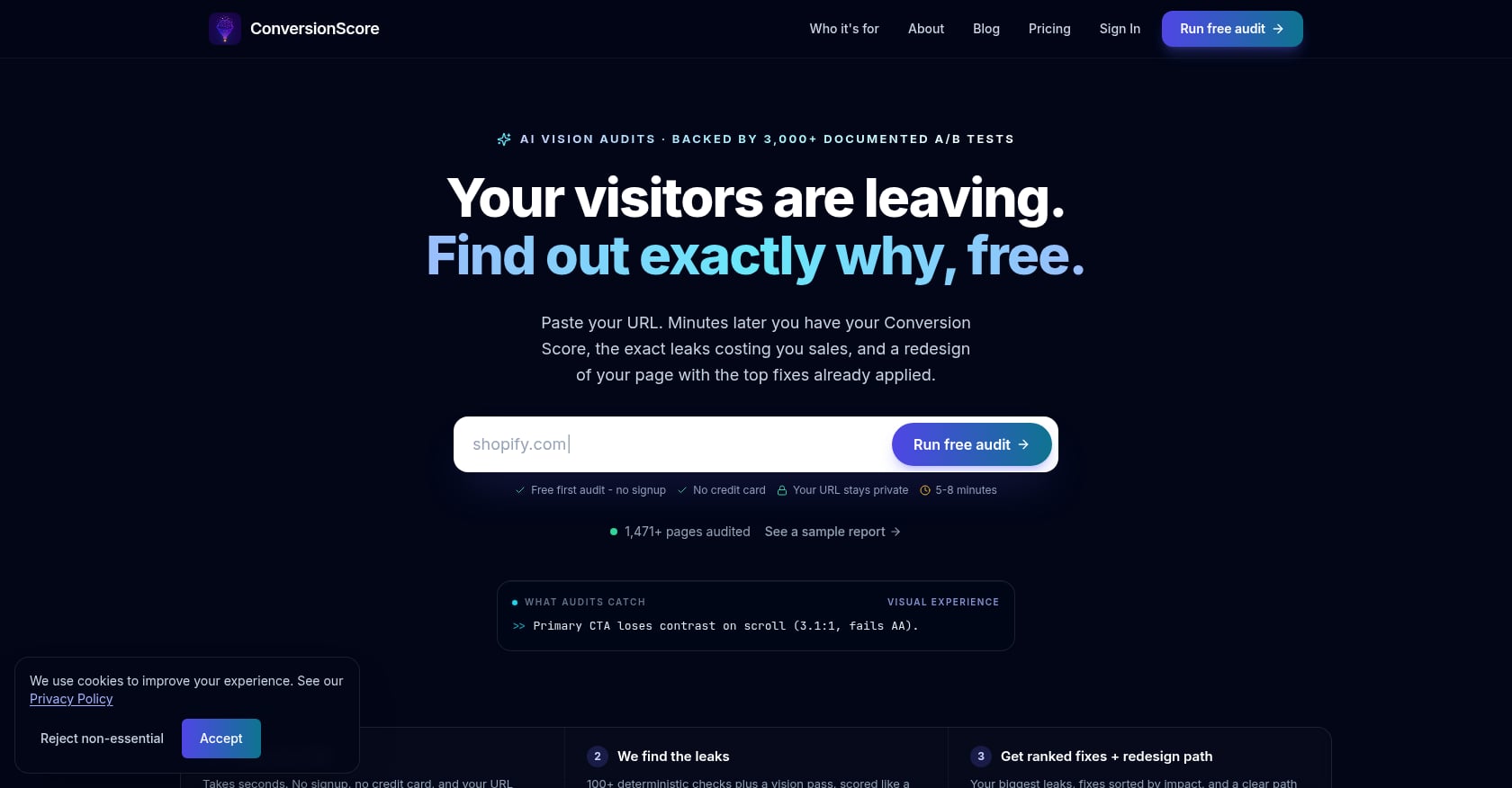
Best for: CRO teams and agencies needing rapid pre-test diagnostics to decide which tests to run first.
Pricing: Free tier with top two insights. Pro at $99/month or $948/year for unlimited audits, competitor analysis, SWOT insights, AI expert chat, and PDF exports.
Key features:
- Uses GPT-5 Vision combined with DOM analysis to audit pages across six weighted pillars: Clarity and Value, Offer Strength, Trust and Credibility, Friction and Usability, Urgency and Motivation, and Visual Experience.
- Generates prioritized recommendations that function as structured test hypotheses, each tied to a specific pillar.
- Competitor side-by-side analysis for hypothesis differentiation.
- No script installation required. Audits complete in roughly 90 seconds.
- One-click PDF exports make it agency-friendly for client delivery.
To understand the scoring framework behind these audits, the six pillars of a conversion audit explain how each pillar translates into testable areas.
Tradeoffs:
- Not a testing platform. You still need VWO, Optimizely, or Convert to validate changes.
- AI heuristic audits can surface generic advice if a page’s strategy is intentionally unconventional (for example, deliberately long-form sales pages).
- No behavioral data input, so hypotheses are based on page structure and heuristics, not recorded user sessions.
Practitioner perspective: One CRO consultant noted on Reddit that the biggest waste of money in optimization right now is buying AI tools and plugging them into sites with no hypothesis framework. Tools like Conversion Score work best when you already have a system for turning recommendations into structured, testable ideas.
Run a free analysis to populate your hypothesis backlog in under two minutes.
2. VWO Copilot
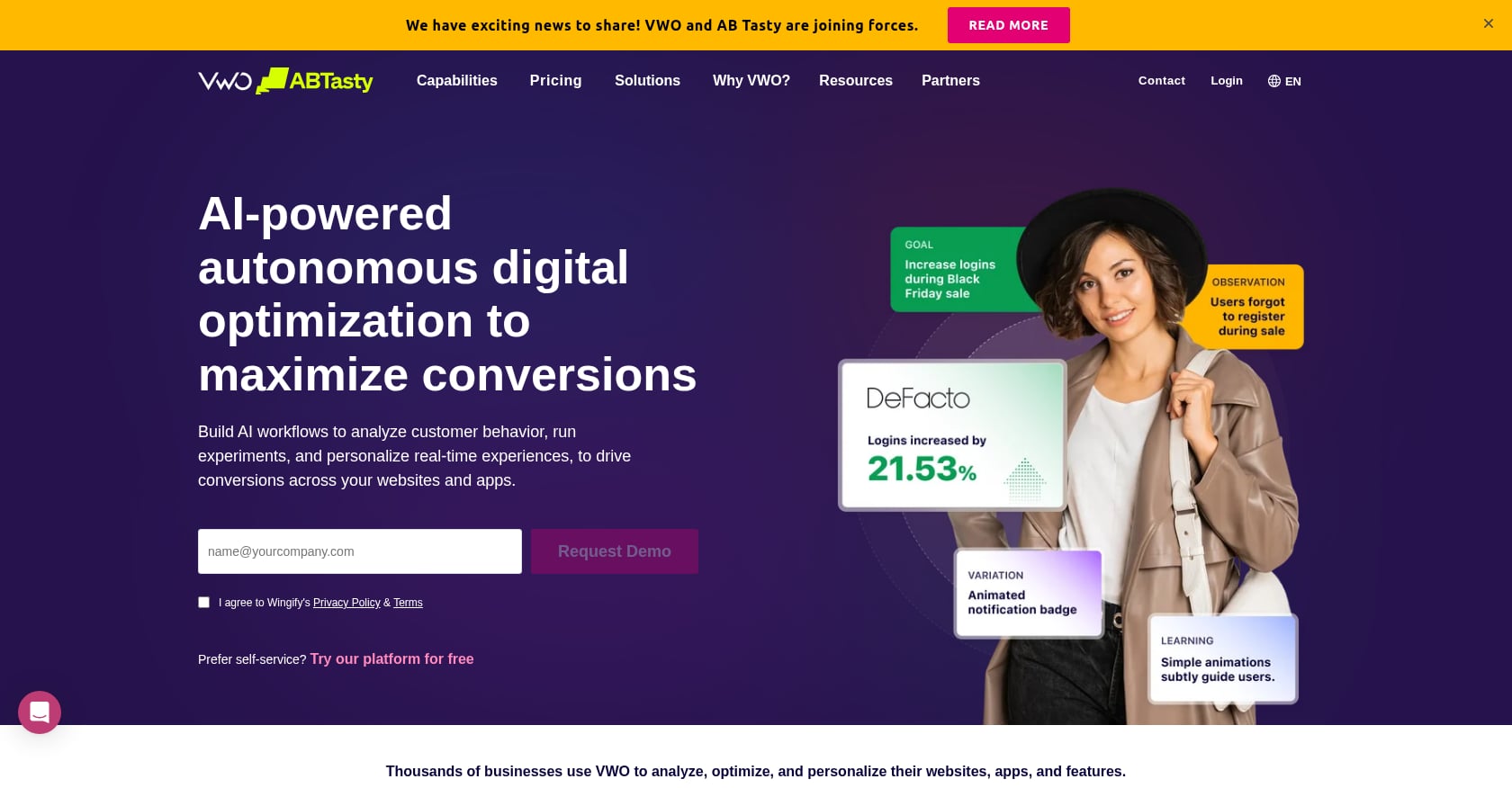
Best for: Mid-market teams that want hypothesis generation embedded directly inside their testing workflow.
Pricing: Starting at $49/month. AI Copilot features available on higher tiers. MTU-based pricing with quote-based tiers for advanced plans.
Key features:
- Agentic optimization system that analyzes user behavior data, identifies friction points, and translates findings into actionable test ideas with rationale.
- Hypotheses are generated within the same platform where you build and run experiments.
- Visual editor and code editor for immediate test creation from generated hypotheses.
Tradeoffs:
- Overage pricing is not publicly disclosed, creating budget uncertainty if you exceed MTU limits. Plan for 120 to 130% of expected volume.
- Requires behavioral data accumulation before AI recommendations become meaningful.
- Lower tiers may not include the full Copilot feature set.
Practitioner perspective: Many users cite responsive support and dedicated success managers as a strong point. However, practitioners on forums report that the real value only kicks in after you have enough traffic data flowing through the platform. For a detailed breakdown of how pre-test diagnostics compare with VWO’s testing capabilities, see this Conversion Score vs VWO comparison.
3. Optimizely Opal
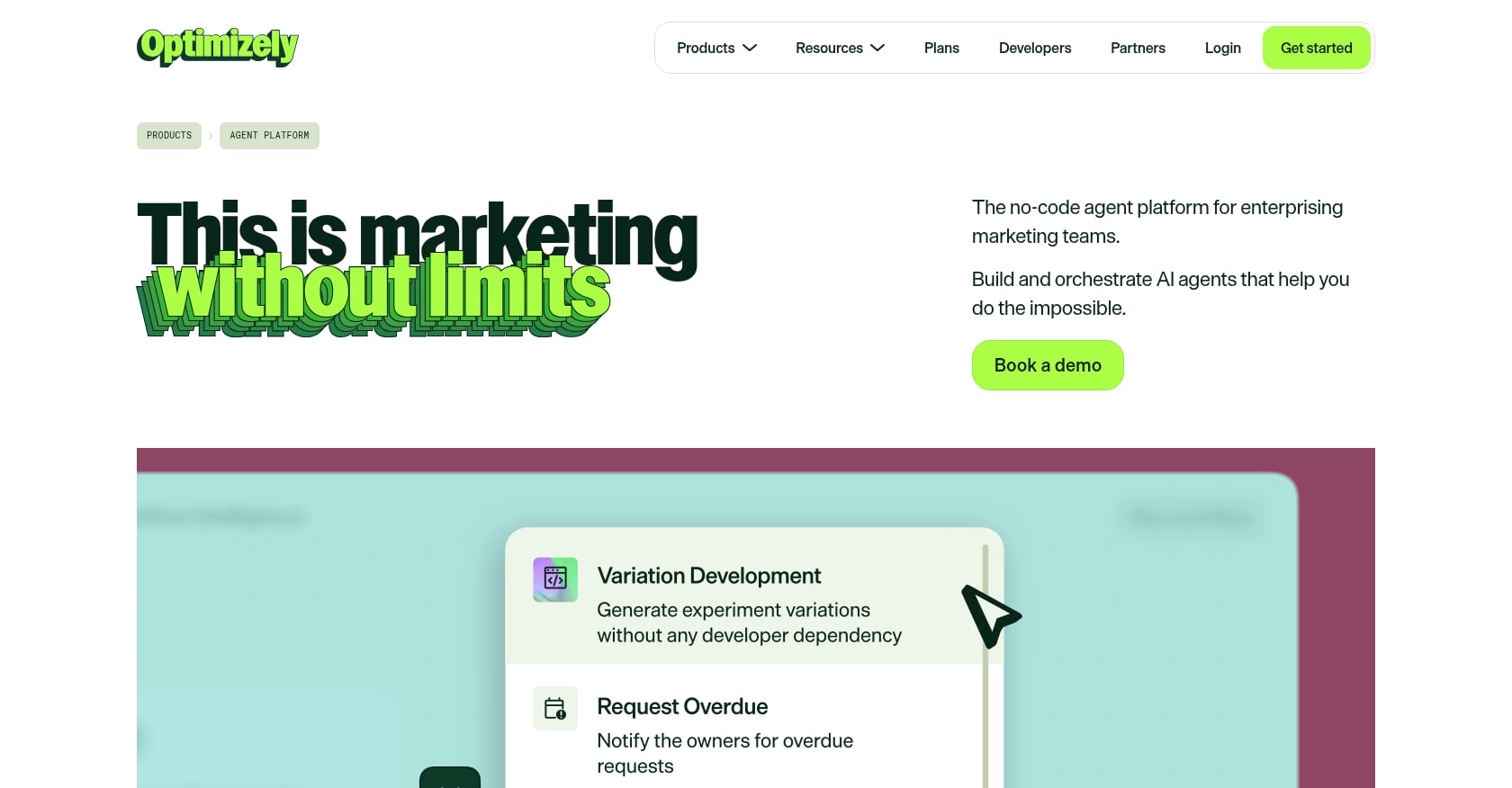
Best for: Enterprise teams with established experimentation programs running 10 or more tests per month.
Pricing: Approximately $50K+ per year based on real-world pricing reports.
Key features:
- Experiment Planning agent transforms raw ideas into fully formed experiment plans with hypotheses, key metrics, risks, and critical assumptions.
- Idea Builder generates experiment ideas based on a target URL or page screenshot, a stated objective, and optional heatmaps or analytics inputs.
- Each idea includes a title, description, problem statement, hypothesis, and source references.
- Benchmarking data shows teams using Opal are running 78% more experiments and seeing 9% better win rates.
Tradeoffs:
- Enterprise pricing puts it out of reach for smaller teams or agencies with limited budgets.
- Complexity requires dedicated experimentation staff to get full value.
- Overkill if you are running fewer than 10 tests per month.
4. Contentsquare Sense AI
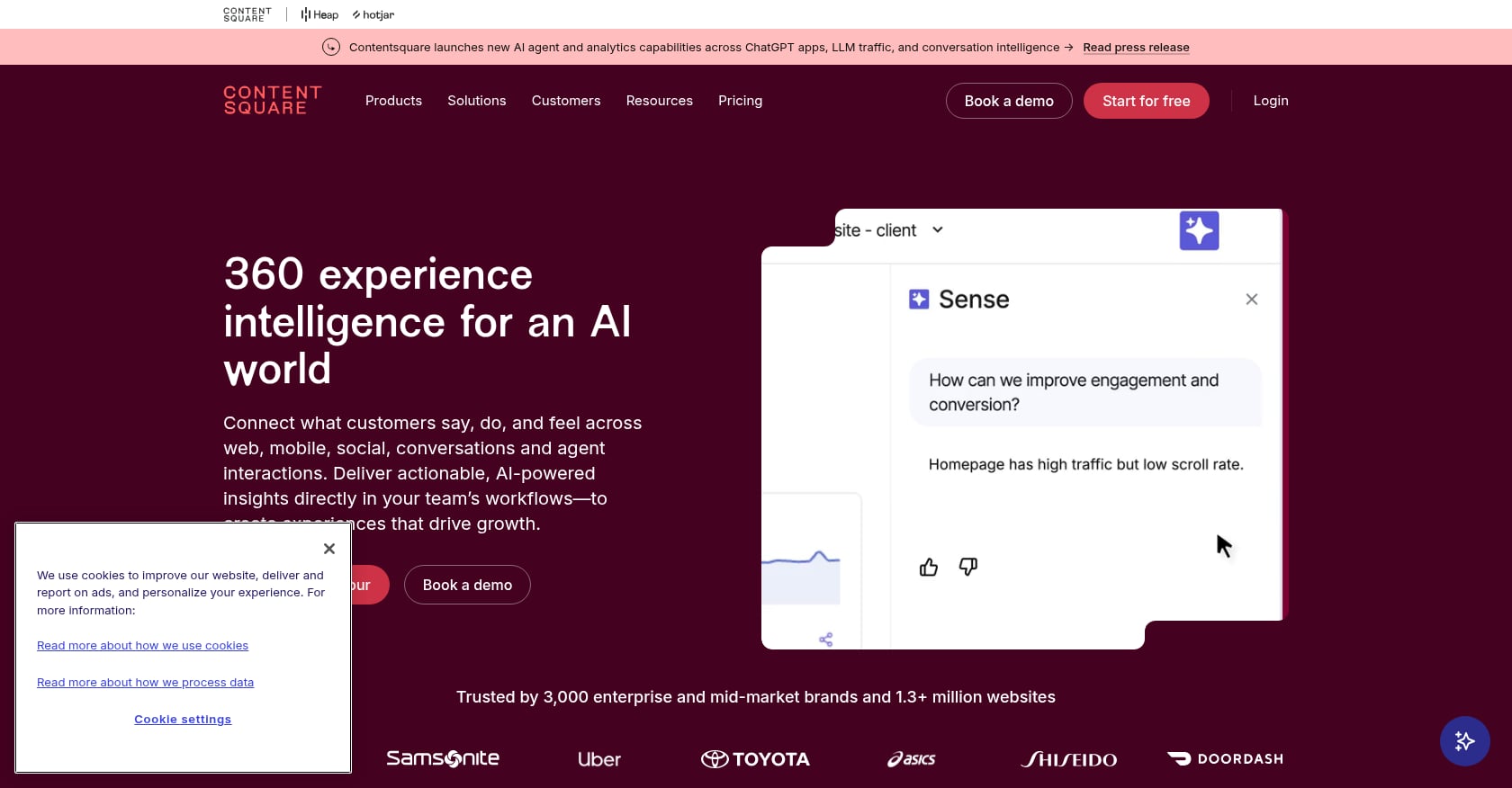
Best for: Large organizations that need behavioral data translated into hypothesis-quality insights at scale.
Pricing: Highly variable, dependent on session volume, number of properties, contract term, and selected modules. Enterprise-focused.
Key features:
- Sense AI lets anyone ask plain-language questions about user behavior and get instant answers without SQL or analytics expertise.
- Sense Analyst is an autonomous AI agent that maps sites, compares journeys, and recommends next actions.
- Functions as hypothesis fuel rather than a hypothesis generator, surfacing the behavioral patterns that inform what to test.
Tradeoffs:
- Not a hypothesis generator per se. You still need to translate behavioral insights into structured test plans.
- Initial setup can be complex and may require extensive training, according to users on Capterra.
- Enterprise pricing and sales cycles make it inaccessible for smaller CRO teams.
5. GrowthLayer
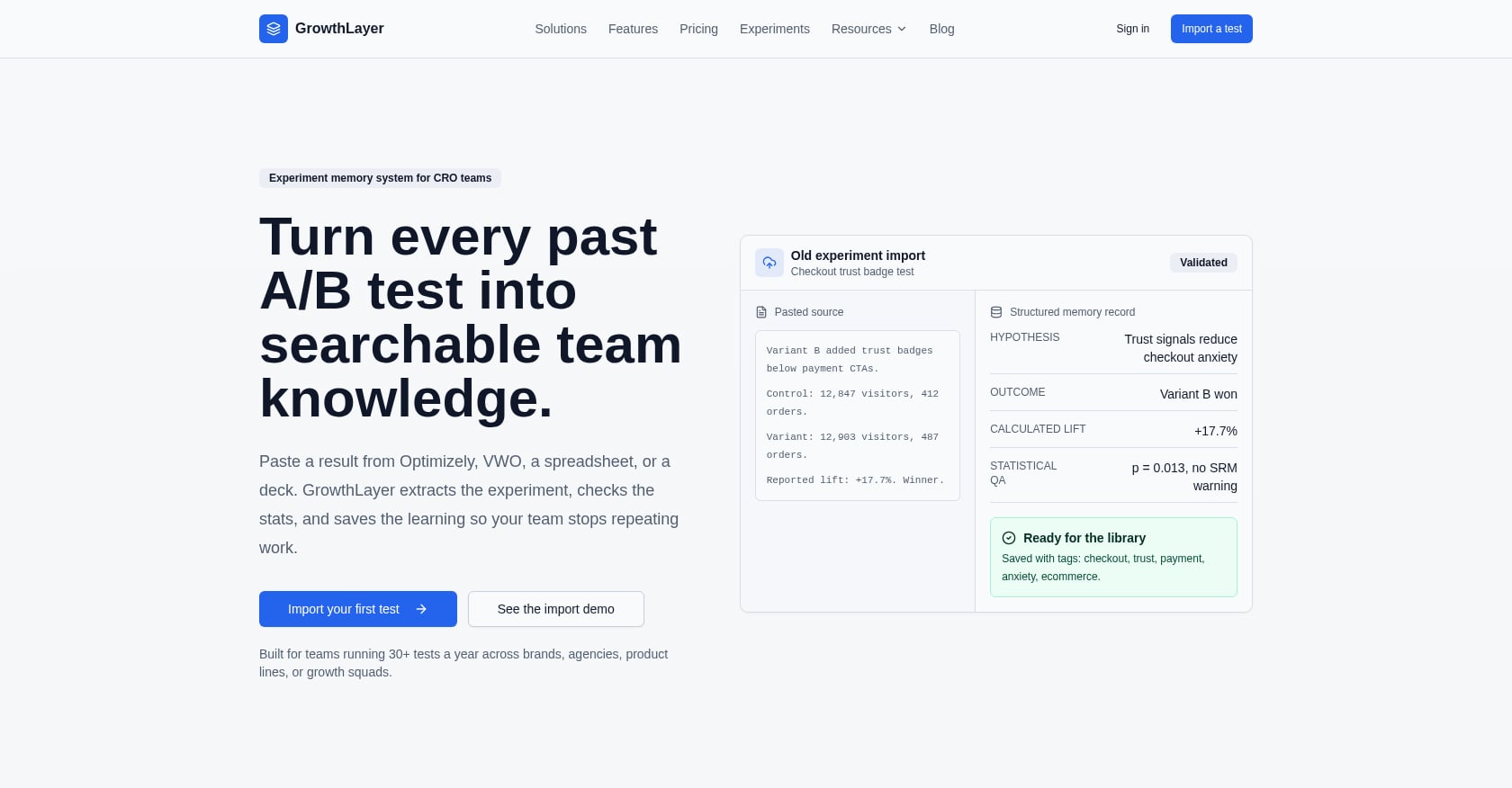
Best for: CRO teams that want to mine their own historical test data for new hypothesis ideas.
Pricing: Not publicly disclosed.
Key features:
- AI auto-tagging suggests categories based on your hypothesis content.
- Based on your results, testing history, and industry patterns, it suggests what to test next.
- Turns every completed experiment into a springboard for the next one.
- Supports the Jobs-to-be-Done framework as a hypothesis source, which practitioners like Atticus Li have described as remarkably useful for CRO hypothesis generation.
Tradeoffs:
- Requires an existing testing history to generate meaningful suggestions. Newer teams will not have enough data for pattern detection.
- Not a testing platform. It feeds ideas into your existing stack.
- Limited public information on pricing makes evaluation harder.
6. ChatGPT or Claude with Structured Prompts
Best for: Budget-conscious teams or solo optimizers who want AI augmentation without committing to a platform.
Pricing: Free to $20/month depending on the model and tier.
Key features:
- General-purpose LLMs can generate hypotheses using structured prompt frameworks like If-Then-Because or Problem-Solution-Result formats.
- Convert’s AI Playbook recommends feeding AI your hypotheses, letting it critique your reasoning, and improving your thinking through conversation.
- Useful for brainstorming volume: quickly generating 20 to 30 hypothesis candidates from a data dump, then filtering manually.
Tradeoffs:
- No behavioral data input. Hypotheses are generic unless you paste in real analytics, heatmap summaries, or session recording notes.
- No prioritization scoring. You will need a separate framework like ICE or EPIC to rank the output.
- Risk of “hallucinated confidence,” where the AI produces explanations that sound convincing but do not hold up when tested. Multiple experts in a Mouseflow roundup flagged this as a common failure mode.
For structuring the hypotheses that come out of LLM sessions, an A/B test planner helps you move from ideas to test-ready plans with sample size calculations.
7. Mouseflow Mina AI
Best for: Teams already using Mouseflow that want AI-augmented behavioral research before writing hypotheses.
Pricing: Freemium plan available. Paid plans scale with session volume.
Key features:
- Mina works as an AI research assistant that helps teams explore behavior data using simple questions.
- Quickly surfaces relevant patterns, friction points, and user segments.
- Natural language interface lowers the barrier for non-analysts to extract insights.
Tradeoffs:
- Locked into the Mouseflow ecosystem. Not useful if your behavioral data lives in another tool.
- Functions as a research assistant, not a hypothesis writer. The translation step from insight to structured hypothesis is still manual.
- Requires sufficient session recording volume to surface meaningful patterns.
8. Breadcrumb.ai
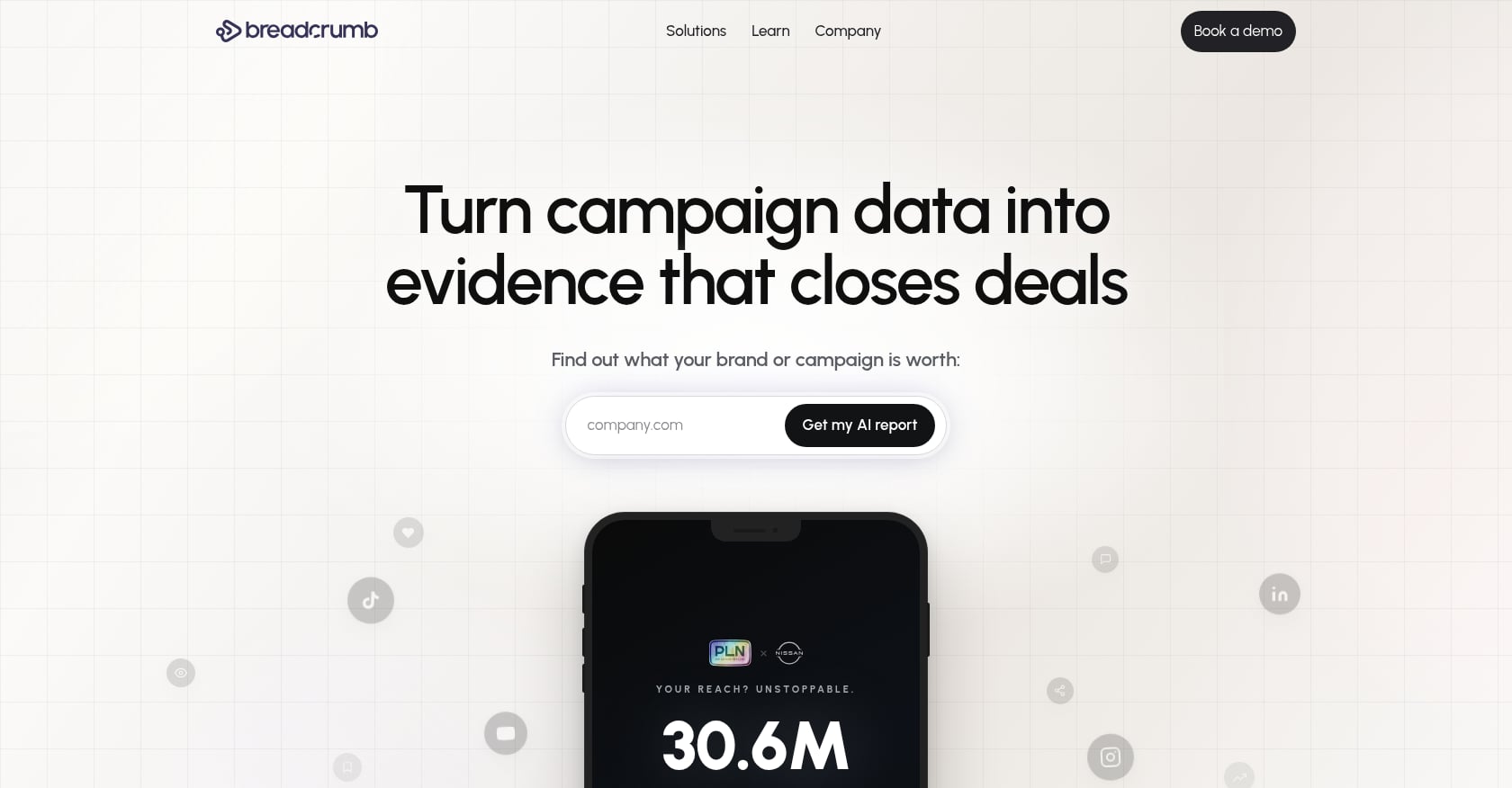
Best for: Data-heavy CRO teams that want to accelerate the analysis-to-hypothesis pipeline.
Pricing: Not publicly disclosed.
Key features:
- Automates the entire data workflow from ingestion and cleaning to analysis and presentation.
- AI agents allow users to ask questions in natural language and receive instant, visual responses.
- Designed to facilitate rapid hypothesis generation by eliminating the manual data-wrangling step that slows most CRO teams down.
Tradeoffs:
- Not CRO-specific. It is a general data analysis tool, so it lacks conversion-focused frameworks or heuristics.
- Requires connecting your data sources, which adds setup time.
- No built-in testing or prioritization features.
The AI Hypothesis Quality Checklist
AI can generate dozens of hypothesis candidates in minutes. The problem is not quantity. It is quality. Use this checklist to evaluate whether an AI-generated hypothesis is actually testable before it enters your experiment queue.
1. Does it name a specific observation?
A good hypothesis starts with something you noticed in the data, not a hunch. “Users drop off on the pricing page” is an observation. “The pricing page could be better” is not.
2. Does it propose a concrete change?
The hypothesis must specify what will be different. “Adding a comparison table above the fold on the pricing page” is concrete. “Improving the pricing page experience” is vague.
3. Does it predict a measurable outcome?
“Will increase plan selection rate by 15%” is measurable. “Will improve conversions” is not specific enough to evaluate.
4. Does it specify the primary metric?
One metric. Not three. AI tools often suggest monitoring everything, which dilutes focus. Pick the metric that most directly maps to the business goal.
5. Is the “because” grounded in data, not assumption?
The If-Then-Because format is standard: If we [change], then [outcome], because [evidence]. That “because” clause needs to reference actual data, whether from analytics, session recordings, survey responses, or competitive analysis. Without it, you are just guessing with extra steps.
This framework aligns with what Linear Design calls the structural foundation of AI-assisted CRO. As they put it, the hypothesis framework is what separates AI that produces signal from AI that produces noise. Understanding how prioritized recommendations work helps you sort through the volume AI generates.
When AI-Assisted Hypothesis Generation Fails
Honest assessment: AI-assisted hypothesis generation for CRO teams fails more often than vendors admit. Here is when and why.
Without a framework, AI gives you expensive randomness. Practitioners on digital marketing forums have been blunt about this. One commenter described teams that spent five figures on platforms they never used past the trial because nobody could write a testable hypothesis. The tool was not the bottleneck. Thinking was.
Fully autonomous AI underperforms human-guided AI. Research from GoGoChimp and Build Grow Scale shows that expert-guided AI delivers 28 to 34% conversion lifts, compared to just 4 to 7% for fully autonomous AI CRO tools. That is a five to eight times difference. The human in the loop is not optional.
Most autonomous AI agent programs will not reach production. Forrester projects that roughly three-quarters of organizations building fully autonomous AI agent systems will not reach production value, primarily due to governance failures. AI in CRO works best when it supports strategic thinking rather than tries to replace it.
Minimum data thresholds matter. Most AI CRO models require a minimum of 1,000 monthly conversions to generate statistically reliable predictions. If your site is below that threshold, AI hypothesis tools may produce confident-sounding recommendations built on insufficient evidence.
The lesson is straightforward. AI accelerates hypothesis generation. It does not replace the CRO thinking that makes hypotheses worth testing.
How to Start: A 3-Step Adoption Path
If you are evaluating AI-assisted hypothesis generation for your CRO team, start small and build confidence before committing to enterprise tooling.
Step 1: Run a quick AI audit to populate your hypothesis backlog.
Pick your highest-traffic page and run it through an AI-powered pre-test diagnostic. The goal is not to find the perfect test. It is to go from zero hypotheses to five or ten candidates in under five minutes. You can quantify the potential impact using a CRO ROI calculator before deciding which tests deserve resources.
Step 2: Score hypotheses using ICE or EPIC frameworks.
Not every AI-generated idea deserves a test. Rank your candidates by Impact (how much will this move the metric?), Confidence (how strong is the supporting evidence?), and Ease (how quickly can we ship this?). Drop anything that scores low on all three.
Step 3: Validate with a testing platform.
Take your top-ranked hypotheses into VWO, Optimizely, Convert, or whatever testing tool your team uses. Run them to statistical significance, which 70% of CRO teams set at 95% or higher. Then feed the results back into your AI tools to improve the next round of hypothesis generation.
This loop, AI audit to prioritization to testing to learning, is where the compounding value of AI-assisted hypothesis generation shows up. Teams embedding AI across the full lifecycle are running 78% more experiments and seeing measurable improvements in win rates.
Start with a free analysis to see what your first round of AI-generated hypotheses looks like.
Frequently Asked Questions
What is AI-assisted hypothesis generation in CRO?
AI-assisted hypothesis generation uses machine learning models, large language models, or behavioral analysis algorithms to identify conversion issues and translate them into structured, testable experiment ideas. Instead of manually reviewing analytics dashboards and heatmaps for weeks, AI tools can surface patterns and propose hypotheses in minutes. The output still needs human review to ensure business relevance and proper test design.
How much faster is AI hypothesis generation compared to manual methods?
Research from Growth Hackers shows that manual hypothesis generation takes two to four weeks from initial insight to a test-ready plan. AI-powered approaches compress that to two to five days. AI-driven CRO can also reduce time-to-insight by up to 70%, according to Growth Hakka’s implementation guide. The speed gain comes primarily from automated data analysis and pattern recognition, not from skipping the thinking step.
Can AI-generated hypotheses replace human CRO strategists?
No. The data is clear on this. Expert-guided AI delivers 28 to 34% conversion lifts, while fully autonomous AI tools deliver only 4 to 7%. AI handles pattern recognition and volume generation well but lacks awareness of business goals, brand constraints, and customer context. The best results come from CRO strategists who use AI to accelerate their workflow, not replace their judgment.
How many conversions does my site need before AI CRO tools work reliably?
Most AI CRO models require a minimum of 1,000 monthly conversions to generate statistically reliable predictions. Below that threshold, the patterns AI detects may be noise rather than signal. Smaller sites can still benefit from heuristic-based AI audits (which analyze page structure rather than behavioral data) but should be cautious about AI recommendations built on thin datasets.
What is the If-Then-Because hypothesis format?
It is the standard structure for CRO hypotheses: “If we [make this specific change], then [this measurable outcome will occur], because [this evidence supports the prediction].” The “because” clause is what separates a real hypothesis from a guess. AI tools can help generate the “if” and “then” components, but the “because” should be grounded in your actual data, whether analytics, user research, or competitive analysis.
Which AI hypothesis generation tool should I start with?
That depends on your current setup. If you have no behavioral data and want fast results, start with a pre-test AI audit tool that only needs a URL. If you already have a testing platform like VWO with accumulated behavioral data, enable its built-in AI features. If you are budget-constrained, structured prompting with ChatGPT or Claude costs almost nothing and can produce useful hypothesis candidates when paired with your own analytics data.
Do AI-generated hypotheses have higher win rates than manual ones?
Not automatically. The win rate depends on whether the hypothesis is grounded in real data and properly structured. Industry benchmarks show that data-informed hypotheses win 20 to 30% of the time regardless of whether a human or AI generated them. The advantage AI provides is volume and speed: more candidates generated faster, which means more tests run per month and more opportunities to find winners.
How do agencies use AI-assisted hypothesis generation for client work?
Agencies typically use AI-powered pre-test diagnostics to rapidly audit client pages, generate a hypothesis backlog, and package findings into client-ready reports. This approach replaces the traditional two-to-four-week audit cycle with a process that takes hours. For agencies evaluating tools specifically for client delivery, this guide to agency CRO report tools covers the packaging and workflow side in more detail.
Read more guides on the CRO blog, run a free conversion audit on your own site, or see Pro plans for unlimited audits.